

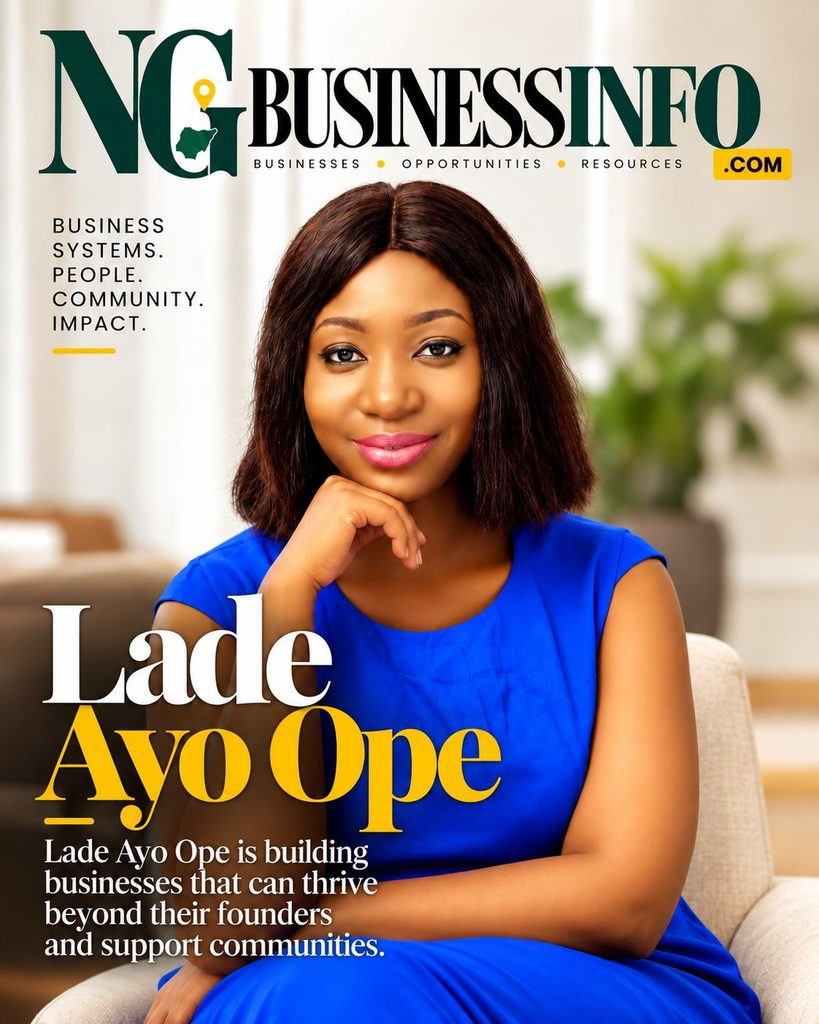
Lade Ayo Ope is building more than businesses. She is building systems that allow businesses to function beyond their founders, creating spaces where entrepreneurs can have honest conversations about the realities of building, and nurturing a community where single parents can find support, understanding and encouragement.
As the Founder and Chief Executive Officer of LAOSOLUTIONS, the business system architect behind Work with Lade, and the convener of Founders Reflect and SUM Fellowship, Lade works at the intersection of business, technology and community development. Although these initiatives serve different purposes, they are connected by a common belief: people and organisations need the right structures and support systems to thrive.
Through Work with Lade, she helps entrepreneurs organise their businesses and build systems that support growth. Through Founders Reflect, she creates room for conversations about the realities of entrepreneurship. And through SUM Fellowship, she is nurturing a faith-based community where single parents can find support and encouragement.
But how did one person come to care so much about business systems, the wellbeing of founders and the experiences of single parents? To understand that, we have to look beyond what Lade is building today and consider some of the experiences that have shaped her.
Lade started LAOSOLUTIONS in 2017, initially focusing on software development. Over time, however, her work began to extend beyond technology. She started paying closer attention to the businesses behind the products, the people running them and the structures that determined whether they could actually work.
And really, a business can have a brilliant idea and a good product and still struggle because the people running it have not figured out how to organise the work, manage their teams or create processes that make things run smoothly.
Sometimes, the founder is the person approving everything, solving every problem and holding the entire business together. Things may work for a while, but what happens when that founder is no longer available? What happens when the business grows and the same way of working is no longer enough?
These are the kinds of questions that sit at the heart of Lade’s work as a business system architect.
Through Work with Lade, she helps entrepreneurs think through their business structures, map their processes, organise their teams and make better decisions about the technology they need. She is particularly interested in working with people at the early stages of building, when an idea is beginning to take shape but the founder may not yet know what it takes to turn that idea into a functioning organisation.
I find this important because we often encourage people to start businesses, but we don’t always talk enough about what comes after the excitement of starting. Having an idea is one thing. Building something that can serve people consistently, manage its resources well and survive beyond your personal involvement is another thing entirely.
And I suspect some of Lade’s understanding comes from having to navigate the realities of building herself.
Her entrepreneurial journey has included difficult partnerships, projects that did not work out as planned, periods of financial uncertainty and the challenge of keeping things moving when opportunities were not coming in. These are not always the parts of entrepreneurship people are eager to talk about. We are more comfortable sharing the launch, the new client, the partnership announcement and the growth figures.
But what happens when the partnership falls apart? What do you do when the contracts stop coming? And how do you keep going when the thing you have put so much effort into is not working the way you imagined?
These are also part of building, even if they don’t always make it into the success story.
For Lade, such experiences have contributed to how she thinks about business today. It is not enough to get something started. There must also be some thought given to what will keep it going.
The people in an organisation need to understand their responsibilities. Processes need to work. Decisions need to be informed by the right information. And technology should solve actual problems rather than simply exist because it is fashionable.
But there is another side to building that has little to do with processes and technology: the person doing the building.
This is where Founders Reflect comes in. Through the community, Lade wants entrepreneurs to have honest conversations about the parts of their journeys that are often left out of discussions about revenue, investment and growth.
I like that this creates room for a conversation we don’t have often enough. We celebrate entrepreneurs for their resilience, but sometimes that celebration comes with an unspoken expectation that they must keep going, no matter what they are dealing with. A founder can be leading a team, making decisions and appearing to have everything under control while privately struggling with the weight of it all.
Having a space where people can speak honestly, learn from one another and feel less alone is a meaningful way to support the people behind the businesses. After all, the business may be what everyone sees, but there is a person carrying the responsibility of keeping it alive.
Lade’s concern for people, however, extends beyond the world of entrepreneurship.

She became a mother as a teenager, an experience that brought its own emotional challenges, including rejection and abuse. That part of her story helps us understand why she would go on to convene SUM Fellowship, a faith-based community for single parents.
SUM stands for Surpassing Ur Mess. The community began with a focus on single mothers and is evolving to create room for men as well. Through fellowship, prayer, worship and shared experiences, the aim is to provide a place where single parents can find spiritual encouragement, understanding and a sense of belonging.
There is something about having lived through a difficult experience that can change how you see other people going through it. You begin to understand that people may need more than advice from a distance. Sometimes, they need a place where they can be honest about their circumstances without feeling that they have to explain or defend themselves first.
For Lade, single parenthood is not simply an abstract social issue. It is an experience she knows something about personally. And while no two people’s journeys are exactly the same, that personal understanding can be a starting point for building a community where people feel seen and supported.
I also think it matters that SUM Fellowship is rooted in faith. For those who draw strength from their faith, fellowship can offer more than a meeting place. It can provide encouragement, connection and the reassurance that they do not have to navigate every difficult season alone.
When you put these initiatives side by side, you might wonder what business systems, founder wellbeing and single-parent support have in common. On the surface, not much. But look a little closer, and a connection begins to emerge.
In each case, Lade is responding to a need for better support. A business needs systems that prevent everything from resting on one person’s shoulders. A founder needs room to acknowledge the pressures of building. And a single parent may need a community that offers understanding and encouragement.
The approaches are different, but all three recognise that people do better when they have the right structures and support around them.
Of course, knowing what needs to be built and actually building it are two different things. Lade is still navigating the realities of running businesses and growing communities, as most entrepreneurs and changemakers do. But what interests me is the direction of her work: moving beyond simply starting things to thinking more intentionally about how they function, who they serve and what will help them endure.
And perhaps this is something worth considering for anyone building a business, an organisation or a community. We spend a lot of time thinking about what we want to create and the people we hope to reach. How often do we stop to ask whether what we are building can continue to serve those people without our constant involvement?
For Lade, that question sits at the heart of her work with LAOSOLUTIONS and Work with Lade. Through Founders Reflect and SUM Fellowship, it takes a different form: creating spaces where people can find support, rather than expecting them to carry everything alone.
She is working across different parts of people’s lives, but the underlying concern remains the same: how do we build things that work, and how do we make sure the people involved are supported along the way?
That, to me, is what makes Lade Ayo Ope’s journey worth paying attention to. It is not just about the businesses she is building or the communities she is bringing together. It is also about learning to think beyond the immediate task and paying attention to what will make the work meaningful and sustainable.
Because having a vision is one thing. Building something that can thrive beyond you is another.
More Stories
Women Founders Take Centre Stage as Wetech 2026 Puts AI, Capital and Innovation in Focus
Damilola Lawal: Building Damilola The Alaga into a Visible Path for the Next Generation of Alagas
Lariat Alhassan’s Larclux Paints Expands Its Footprint in Nigeria’s Paint and Interior Finishing Industry