

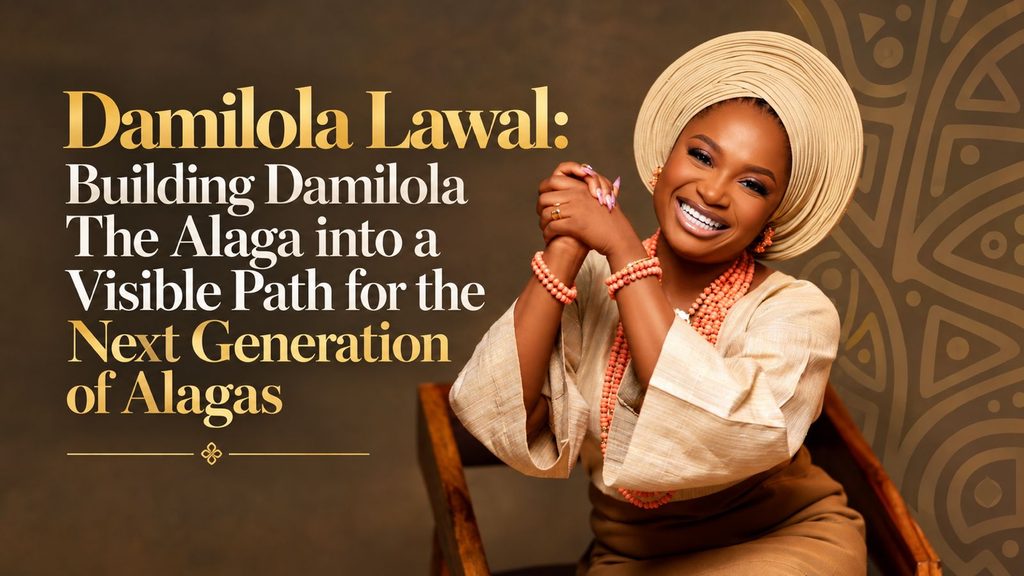
Damilola Lawal, popularly known as Damilola The Alaga (DTA), is a professional Yoruba wedding compere and cultural entrepreneur.
But before the name became a brand, before the academy, the hundreds of weddings and now the book, she was simply Damilola, a young woman from Lagos who went to Olabisi Onabanjo University to study Public Relations and Communications.
And I think that part of her story is worth paying attention to.
Because if you understand anything about Yoruba traditional weddings, you know that the ceremony is hardly complete without an Alaga. There is the Alaga Iduro, the standing compere representing the groom’s family, and the Alaga Ijoko, representing the bride’s family. Sometimes they are two different people; sometimes one person is skilled enough to take on both roles. They are there to guide the ceremony, welcome and engage the families, lead the songs and chants, keep the proceedings moving and, perhaps most importantly, know how to hold a room.
Growing up in Lagos, Damilola would have seen Alagas at weddings. The role would not have been unfamiliar to her. But there is a difference between seeing something at weddings and imagining that it could become your profession.
For Damilola, that possibility came during an ASUU strike. An Alaga had come for her sister’s wedding, and although she did not immediately think much of it, she kept the role at the back of her mind. When she was asked what she wanted to learn during the strike, she said Alaga.
It was not necessarily an obvious choice for a young woman who had grown up shy. Her mother did not initially buy into the idea, but her sister encouraged her, and Damilola went for her first live event. From that very first day, she sang.
That first live event would become the beginning of a career that has since grown far beyond that first decision to learn.
For a young woman with a university degree in Public Relations and Communications, there must have been a point when the question of what came next was not so straightforward. You have graduated. You are young. You are educated. You are articulate. You are beautiful. You can walk into a room and carry yourself with confidence. There are so many careers society readily recognises as the next logical step.
And then there is Alaga.
A profession deeply rooted in culture, performance and tradition, but one that, for many people, was not necessarily what came to mind when they imagined the career of a young university graduate.
I find that tension fascinating.
Because imagine walking into a traditional wedding as a young Alaga when the room has grown accustomed to seeing someone older behind the microphone. Imagine the questions, even if they are never spoken aloud. Are you experienced enough? Do you know what you are doing? Why this? With your education, could you not be doing something else?
These are the kinds of questions that can make a person question whether the path they have chosen is really the path they should remain on.
We do not always talk about that part of building a career. We talk about the successful woman after she has become successful, but rarely about the period when she is still becoming. The period when the work is not yet glamorous, when people may not understand what you are building, and when you are still trying to convince yourself that the thing you have chosen is worth staying with.
That is why Damilola’s resilience is such an interesting part of her story.
Because eventually, the question stops being, “Is this really my path?” and becomes, “How far can I take this?”
And Damilola took it seriously.
She came into the profession with a university education in communication. She had studied a field concerned with audiences, messaging, presentation and the art of communicating with people. Then she entered a traditional space where those same abilities mattered, only now the audience was a wedding hall, the message was embedded in Yoruba culture and the microphone was not simply for speaking. It was for carrying an entire ceremony.
It is difficult not to see the connection.
An Alaga has to understand people. She has to read a room. She has to know when to speak, when to sing, when to make a joke and when to recognise that a moment is too important to turn into entertainment. She has to understand the traditions she is representing and still be able to connect with a modern audience.
Damilola built her career at that intersection.
And perhaps the strongest evidence that she had found something she could sustain is in the sheer stamina the work demands. Wedding seasons can mean long hours, intense preparation and, sometimes, multiple events one after another. Yet Damilola has continued to show up, again and again, carrying the microphone, carrying the ceremony and carrying the expectations that come with being the person everyone is looking to.
That kind of consistency tells you something about a person.
There is strength in being able to keep returning to the same path long enough for the path to begin to look like a career.

By 2019, Damilola The Alaga had become a business, and what followed was the steady transformation of a traditional role into a modern professional enterprise. She became known for conducting Yoruba traditional weddings, but she did not stop at the ceremonies themselves. She built a reputation, developed a distinctive identity and began training people who wanted to enter the profession.
In 2024, she was recognised among Nigeria’s 40 Under 40 CEOs, at a time when she had already trained more than 100 aspiring engagement comperes across Nigeria, the United Kingdom, United States, Ireland, Australia and Canada and had created memories with almost 600 families.
That is a remarkable number, but I think the more interesting part is what the number represents.
It means that Damilola has not simply been doing the work. She has been creating a path into the work for other people.
Today, that work has grown into DTA Academy, the Damilola The Alaga School of Traditional Compering, where the craft and business of engagement compering are taught more deliberately. Her professional identity now sits across several things, Alaga, compere, trainer, musician and cultural entrepreneur.
And somewhere along that journey, Damilola became more than a person young people could learn from.
She became someone they could look at and think, “So this can actually be a career.”
I think that is an important kind of representation.
Not the kind that requires a speech or a campaign. Sometimes, representation is simply watching someone take something you had always considered ordinary, traditional or even informal, and build something serious from it.
A young woman can be educated, have a degree in communications, understand modern media and still choose to build her career around Yoruba culture.
She can stand behind a microphone and not apologise for the fact that what she is doing is traditional.
She can take the skill seriously enough to build a business around it.
And she can make enough room in that business for other people to come in.
That is what Damilola has done.
She has trained over 100 aspiring Alagas across different countries. She has worked with hundreds of families. She has become a recognised name in Yoruba traditional weddings, and more recent profiles now place her experience at about 1,000 traditional Yoruba and intertribal weddings.
But even that is not where her story ends.
Because Damilola has also begun to preserve the very things she performs.
In July 2026, she released Damilola The Alaga Volume 1, a collection of traditional Alaga songs including Orin Ijebu, Orin Eko, Orin Egba, Orin Awori, Orin Ikorodu and Orin Epe.
And now comes the book.
The Alaga Handbook for Beginners.
When I first looked at what the book was trying to do, I realised it fits almost perfectly into the story Damilola has been telling through her career.
She has spent years doing the work. Then she began teaching the work. She started creating music around the work. And now she is documenting the work.
The handbook introduces beginners to traditional engagements, introduction ceremonies, intertribal weddings, songs and chants, ceremony etiquette and the practical realities of becoming an Alaga. It even comes with a QR code that takes readers to recordings of traditional songs and chants, so that they can listen to them and practise them.
That detail is important.
Because you cannot really learn this craft from words alone. You have to hear the songs. You have to feel the rhythm. You have to understand the call and response. You have to practise until the words become familiar enough to come naturally when you are standing in front of a room full of people.
So the book is not simply Damilola writing down what she knows.
It is Damilola trying to make the road she has travelled a little clearer for the person coming behind her.
And perhaps that is the most beautiful thing about where her journey has brought her.
She may not have set out to become the person who would make the Alaga profession look different to a younger generation. But today, a young woman watching Damilola work can see something that may not have been as obvious before: your ability to speak, perform, understand people and carry culture can be more than something you are naturally good at. It can become a profession. It can become a business. It can become a body of knowledge.
And it can eventually become something you hand over.
That, to me, is what The Alaga Handbook for Beginners really represents.
It is not just a book about how to become an Alaga.
It is a woman who has spent years behind the microphone saying, in her own way, “I have learnt this. I have built something from it. Now let me show you how you can begin.”
And perhaps that is how a profession grows, not only when one person becomes good at it, but when that person turns around and makes the path visible for the people coming next.




More Stories
Women Founders Take Centre Stage as Wetech 2026 Puts AI, Capital and Innovation in Focus
Lariat Alhassan’s Larclux Paints Expands Its Footprint in Nigeria’s Paint and Interior Finishing Industry
Anna Fonong Is Building a Culinary Legacy One Meal, One Business and One Student at a Time