
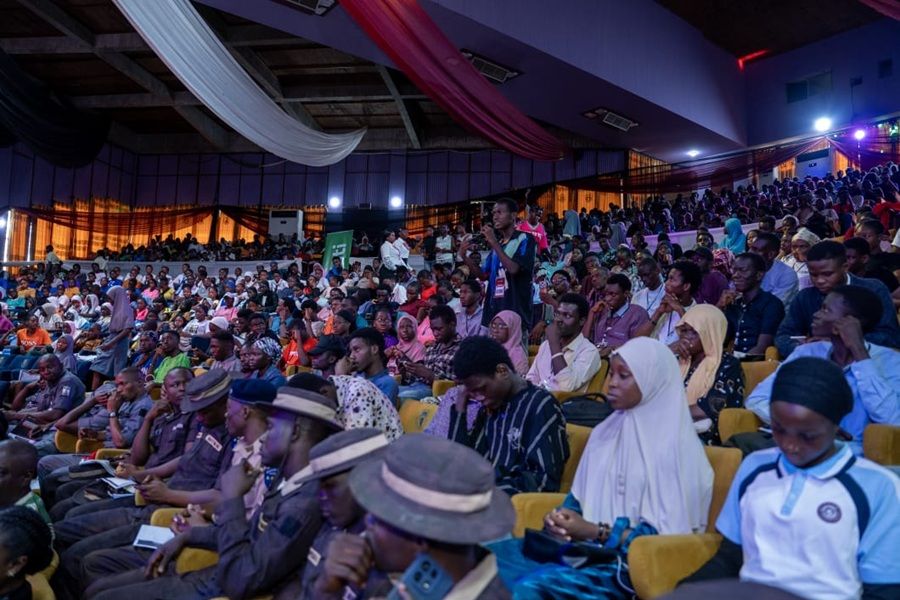
\ More than 2,000 students, researchers, academics, technology professionals, entrepreneurs and AI enthusiasts gathered in Ile-Ife for a conversation that is becoming increasingly urgent for Africa: who will build the people, knowledge and institutions that will define the continent’s place in the age of Artificial Intelligence?
The question took centre stage at the 2026 ACAI Summit, organised by the American Center for Artificial Intelligence (ACAI) at Oduduwa Hall, Obafemi Awolowo University, Ile-Ife, on August 27.
Held under the theme “Artificial Intelligence for National Development, Research Excellence and Economic Transformation,” the summit brought together stakeholders from government, academia, technology and industry to examine how Nigeria and other African countries can move beyond consuming AI technologies to developing the talent, research and solutions needed to shape the global AI economy.
Representing the Director-General and Chief Executive Officer of the National Information Technology Development Agency (NITDA), Kashifu Inuwa Abdullahi, at the summit was Lawrence Dirisu, Director, South West Zone, NITDA.
In his remarks, Dirisu stressed that Artificial Intelligence is already influencing how governments, businesses, universities and individuals operate, making investment in digital skills, infrastructure and responsible innovation increasingly important.
He noted that Nigeria possesses both the human capital and population needed to become a significant participant in the global digital economy, but sustained investment will be required to translate that potential into impact.
For ACAI, the summit was designed to go beyond conversations about AI trends.
Dr. Olusola Amusan, Director of the American Center for Artificial Intelligence, said the turnout demonstrated the growing appetite among Nigerians, particularly young people, to understand and participate in the AI economy.
“There is a huge appetite for knowledge, opportunity and participation in the AI economy,” Amusan said. “Our responsibility is to make sure that this interest is converted into skills, research, businesses, jobs and solutions that can have real impact.”
The choice of Ile-Ife as the venue was also deliberate.
According to Amusan, the city’s long history as a centre of scholarship, intellectual development and culture made it an appropriate setting for a conversation about the next major chapter in human knowledge.
“Ile-Ife has always represented knowledge, scholarship and culture. AI represents another major chapter in the evolution of knowledge, and we believe Africa should be part of writing that chapter.”
The summit featured speakers and contributors from academia, government, technology and business, including Professor Boniface Kayode Alese, Professor of Information and Cyber Security and Dean of the School of Computing at the Federal University of Technology, Akure; Oluwamuyemi Orimolade; Emmanuel Asika, technology executive and former Country Head, Nigeria, HP Inc.; Bamidele Ogunmakin, Software Architect at Microsoft; Barrister Abimbola Amusan, Co-Founder and Chief Operating Officer of Vesti Technologies Inc.; Freda Anyanwu, Africa Director, Global AI Council; Olufemi Olumide; Mercy Frank; Olubunmi Opadoyin; Austin Emenike; and Dr. Olujoke Mubo Oni.
The Vice-Chancellor of Obafemi Awolowo University was represented by the Deputy Vice-Chancellor, Innovation and Development, Professor Akanni Ibukun Akinyemi, further reinforcing the importance of connecting higher education with emerging technologies and the changing demands of the global economy.
Discussions at the summit covered AI research, education, cybersecurity, digital transformation, entrepreneurship, innovation and the future of work, with participants examining how increasingly capable AI systems could affect Nigerian businesses, universities, public institutions and the wider economy.
A major emphasis throughout the gathering was the need to invest in people.
While access to AI tools is expanding rapidly, participants highlighted the importance of developing researchers, engineers, entrepreneurs, educators and technology professionals who can build and adapt solutions for African realities.
The summit also marked another step in ACAI’s broader work to develop a community around AI research, education and responsible application.
For Amusan, the gathering is intended to become the beginning of sustained collaboration rather than a one-day event.
“The summit is not meant to be a one-day conversation,” he said. “We want to build relationships that continue after the event.”
He explained that the long-term vision includes stronger collaboration among researchers, greater access to opportunities for students, stronger AI programmes within universities, better connections between companies and talent, and increased institutional capacity to apply AI to real-world challenges.
c
The 2026 ACAI Summit ultimately underscored a simple but significant message: Africa’s AI future will not be determined only by the technologies it adopts, but by the people, institutions and ideas it chooses to invest in today.
And from Ile-Ife, that conversation is already underway.

More Stories
At UNGA 81, Boys Lead Foundation Brings the Future of Boys and Young Men Into Focus
Bolutife Awakan Helps More Than 1,500 African Women Build Careers in Technology
Women Founders Take Centre Stage as Wetech 2026 Puts AI, Capital and Innovation in Focus