
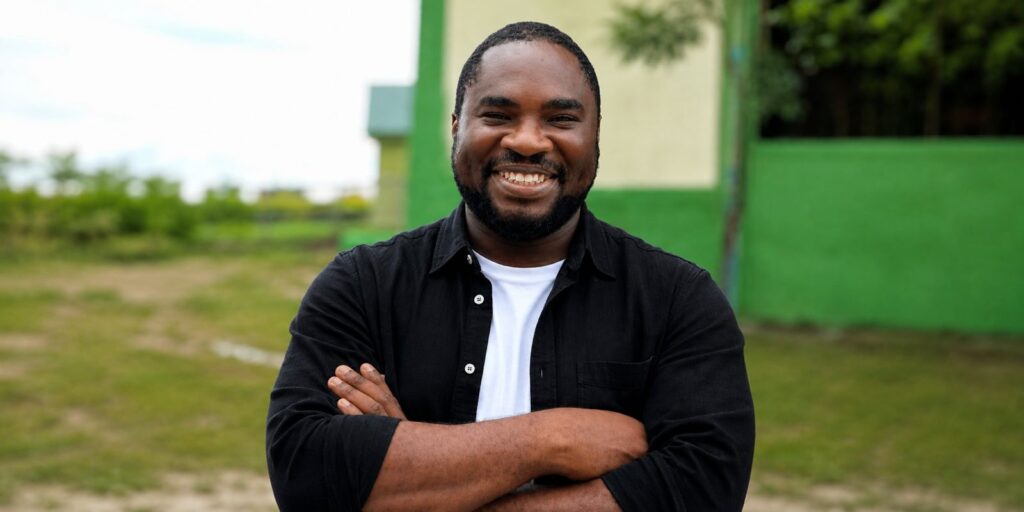
Long before he founded Aiki Hub Technologies, Oluwaseun Olorunmeye Daniel was already building things.
As a student in Nigeria, he developed a computer-controlled robotic system designed to help with minor household chores. In 2004, that project took him to the International Computer Project Olympiad in Ashgabat, Turkmenistan, where he won a gold medal.
It would be easy to look back at that moment as the beginning of a technology career. But perhaps it was something simpler: an early glimpse of a pattern that would follow Oluwaseun for years.
He builds.
Machines. Businesses. Music. Software. Digital products.
And today, that instinct to build sits at the heart of Aiki Hub Technologies, the Nigerian technology company he founded to design, develop and deploy digital products across different sectors.
Oluwaseun’s journey has never followed a single straight line.
One chapter took shape through AnielWorks, an IT company where he mostly developed websites and other digital solutions. It was another early expression of his interest in using technology to create practical solutions for people and organisations.
Then there was music.
Oluwaseun was a founding member and lead vocalist of The Isomers, an Abuja-based Nigerian indie-folk band formed in 2012. He also played guitar, bringing another kind of creativity into a life already deeply connected to technology.
Technology and music may appear to belong to different worlds, but for someone with a builder’s instinct, the connection is not difficult to see.
Both begin with an idea.
Both require experimentation.
Both involve creating something that did not exist before.
And that may be the best way to understand Oluwaseun.
He has never seemed particularly interested in staying inside one box.
The technology changed. The medium changed. The problems changed.
The building did not stop.
That same instinct now finds its clearest expression in Aiki Hub Technologies.
The company is focused on building digital products across different sectors, with work that includes AikiFlow, AudioAiki and AikiPrep, alongside technology projects exploring artificial intelligence and other emerging possibilities.
One of the more technically interesting examples is the Aikihub Competence Engine, an open-source adaptive conversational competency evaluation engine.
The project explores how artificial intelligence can be used to make competency interviews more dynamic. Rather than taking every user through exactly the same sequence, the system can select follow-up questions based on gaps in the evidence gathered from previous responses. It extracts evidence from the conversation, connects that evidence to the assessment and uses deterministic rules to calculate proficiency, while separately measuring confidence in the available evidence.
It is the kind of project that reveals something about the builder behind it.
The interest is not simply in using AI because AI is fashionable. It is in exploring what the technology can actually do when applied to a specific problem.
That approach also extends to the work Aiki Hub does for other ventures.
Aiki Hub Technologies is also building technology for other ventures. One example is Voluserve, a digital venture focused on volunteering, learning, impact and talent development. Aiki Hub serves as Voluserve’s technology development partner, providing the technical expertise and product development behind the platform.
For Oluwaseun, that is another version of the same work he has been doing for years: taking an idea and helping turn it into something tangible.
It is why “developer” alone does not quite capture the story.
A developer can build what has been specified.
A builder asks what should exist in the first place.
That distinction appears repeatedly throughout Oluwaseun’s journey, from the student who imagined a computer-controlled robot that could help around the house, to the person building websites through AnielWorks, to the musician who helped build a band and its sound, and now to the founder building a technology company around digital products and emerging technologies.
There is a creative thread running through all of it.
There is also a practical one.
The question is rarely just, Can this be built?
It is closer to:
What can we build with this?
That question becomes particularly relevant in Nigeria’s growing technology ecosystem, where the opportunity is no longer simply to consume technology created elsewhere, but to build products that respond to local problems, local markets and local possibilities.
Aiki Hub Technologies sits within that opportunity.
Its products may continue to evolve. Its areas of work may expand. New technologies will inevitably change what is possible.
But the underlying instinct is familiar.
See something that could work differently.
Imagine what could be built.
Then build it.
For Oluwaseun Olorunmeye Daniel, that instinct started with a robot.
More than two decades later, it has become a company.
And if his history is any indication, Aiki Hub Technologies may not be the final thing he builds.
It may simply be the next one.

More Stories
Bolutife Awakan Helps More Than 1,500 African Women Build Careers in Technology
Women Founders Take Centre Stage as Wetech 2026 Puts AI, Capital and Innovation in Focus
PowerGen Is Expanding Nigeria’s Mini-Grid Business With $5 Million in New Investment